
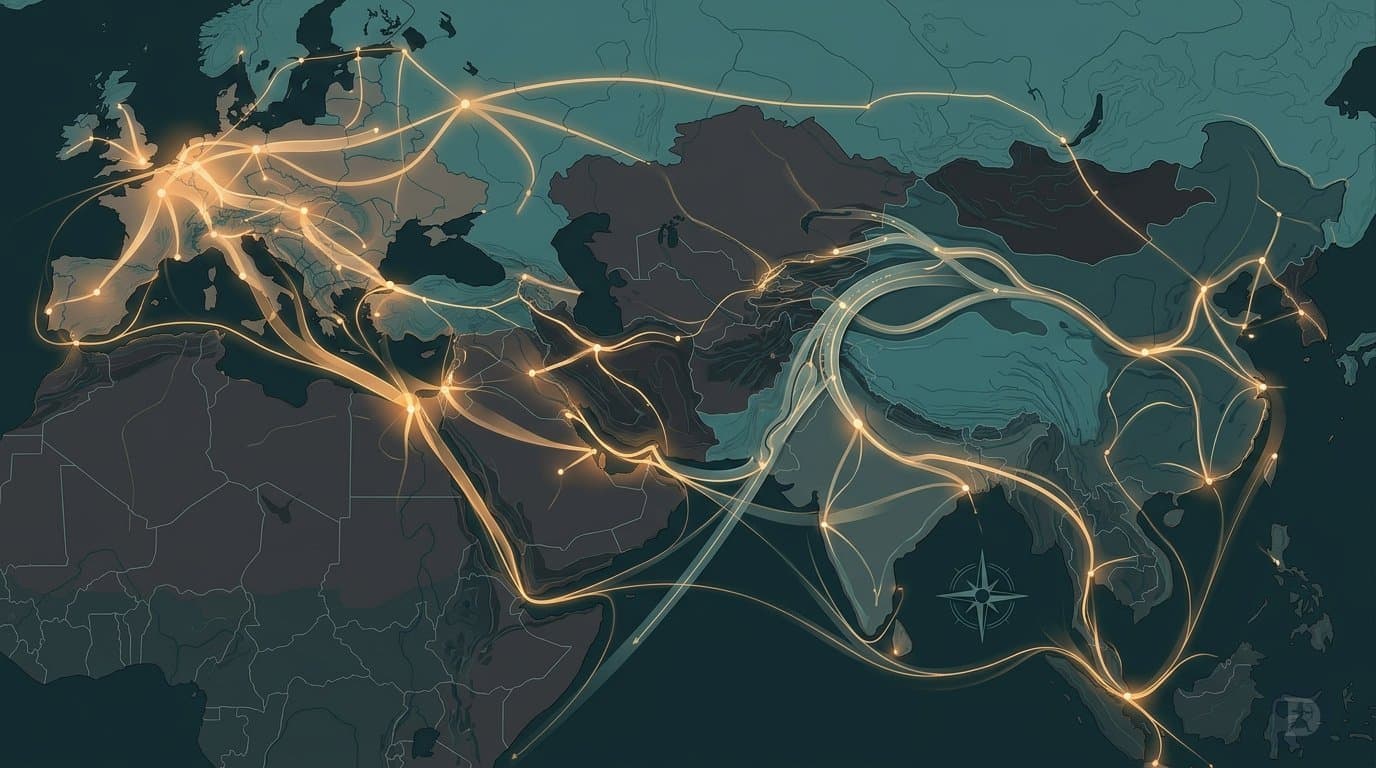
The Great Geoeconomic Realignment: Turkey’s Export Hegemony and Iran’s Inevitable Pivot to a Consumption and Transit Paradigm
The geopolitical and economic map of the Middle East is undergoing an accelerated and critical structural shift. For decades, Iran’s macroeconomic strategy was based on an asymmetric price advantage in neighboring markets, underpinned by the continuous depreciation of the Iranian Rial (IRR). However, the 2020–2024 period exposed the severe limitations of this model. Turkey’s policy of competitive, managed depreciation of the Lira (TRY), combined with its unfettered access to global financial systems, systematically eroded Iran’s export advantages in strategic regional markets. What was initially analyzed as a "gradual erosion" and a structural transition from an industrial, export-oriented economy to a consumer market and transit corridor—resembling the pre-diversification model of the UAE—has, with the onset of 2025 and 2026, transformed into a sudden and catastrophic structural shock driven by the macro-variable of "war."
Part I: The Crisis Timeline — From the Snapback Mechanism to Governance Shock
Analyzing the current dynamics of the Iranian economy is impossible without considering the chain of military and political events of the past year. These events have rewritten the institutional and operational landscape of the country's economy:
- June 2025: The "Twelve-Day War" between Israel, the United States, and Iran, involving airstrikes on key nuclear facilities (Fordow, Natanz, and Isfahan), which ended with a temporary ceasefire on June 24.
- September 2025: Activation of the "snapback" mechanism by the E3 (France, Germany, and the UK) at the UN Security Council, leading to the full reinstatement of previous UN sanctions (including arms and missile embargoes and asset freezes) after a decade-long hiatus.
- December 2025 – January 2026: The emergence of the largest wave of nationwide livelihood and political protests in response to the unprecedented collapse of the national currency and the paralysis of businesses, met with severe security crackdowns.
- February 2026: The launch of a major joint US-Israeli military operation dubbed "Operation Epic Fury" and the assassination of the then-Leader of the Islamic Republic in Tehran, leading to a transfer of power to his son and the formation of an interim leadership council amidst the crisis.
- March 2026: An attack on the South Pars gas field and the Asaluyeh refineries, resulting in the loss of the bulk of the country's gas production capacity, followed by Iran’s retaliatory strikes against regional energy infrastructure.
- April 2026: A two-week ceasefire brokered by Pakistan following the practical blockade of the Strait of Hormuz (the chokepoint for 90% of Iran’s foreign trade).
- June – July 2026: The signing of a 60-day interim agreement on June 17, followed by its collapse in July after renewed maritime tensions, leading to the lifting of the ceasefire and the intensification of transit sanctions.
This chain of crises has inflicted over $270 billion in damages to Iran's infrastructure and economic fabric, completely dismantling previous models of economic equilibrium.
Part II: Asymmetric Currency War in a Macro-Crisis Scenario
To understand the depth of this rupture, one must first note the differing nature of currency depreciation in the pre-war era. Between 2020 and 2024, the Turkish Lira lost about 75% of its value against the dollar, while the Iranian Rial faced a decline of nearly 85% in the free market; yet, the transmission mechanisms of these depreciations were entirely different. In Turkey, the Lira’s depreciation was a deliberate, state-supported monetary tool that kept the country’s manufactured goods competitive in global markets by maintaining a low Real Effective Exchange Rate (REER), while simultaneously preserving access to imported raw materials. Turkey absorbed global raw materials at a discount provided by the cheap Lira, processed them, and exported high-value-added products. In contrast, the fall of the Rial was from the outset a sign of macroeconomic instability, cost-push inflation caused by sanctions, and capital flight; the weak Rial never functioned as a genuine export subsidy, but rather increased the cost of imported intermediate goods and further weakened the country’s industrial capacity.
Although this divergence in REER between the Turkish Lira and the Iranian Rial was a structural reality between 2020 and 2024, the shocks of 2026 have turned this gap into a complete rupture. The fall of the Rial is no longer merely a monetary tool or an inflationary effect, but a direct reflection of the maritime blockade, snapback sanctions, and geopolitical insecurity.
In the free market, the dollar rate, which stood at 600,000–700,000 Rials before the war, reached the 1.86–1.92 million Rial range by late July 2026, touching the 1.96 million ceiling at the height of the crisis. The Nima exchange rate (approx. 1.48 million Rials), with a 21% gap from the free market, has effectively lost its allocative function. The lack of official GDP statistics since 2024 and frequent internet blackouts have limited access to precise data, but IMF estimates indicate a 6.1% contraction of the Iranian economy in 2026, accompanied by persistent inflation of 69–70%. Conversely, Turkey has solidified its superior position with 3.4% economic growth and more controlled inflation of 28.6%. Iran’s current account balance has also shifted from a 0.6% GDP surplus to a 1.8% deficit.
Part III: Market Rearrangement in the Shadow of the Hormuz Blockade
Before the onset of military crises, the trend of market shifts was heavily in Turkey’s favor. In 2023, Turkey’s non-oil exports to Iraq reached approximately $12.5 billion, consisting mainly of high-value consumer goods, processed foods, and construction materials; in the same period, Iran’s non-oil exports to Iraq stalled at around $6 billion, gradually limited to low-efficiency agricultural products, electricity, and petrochemical intermediates. In Central Asia, between 2022 and 2024, Turkey’s exports of durable goods and textiles to Uzbekistan and Kazakhstan grew by an average of 18% annually, while Iran’s export growth to the region was only 3%—a gap primarily caused by the superiority of Turkey’s trade finance tools (such as broad access to letters of credit) and preferential trade agreements. However, the February 2026 war and the practical blockade of the Strait of Hormuz temporarily inverted this equation:
- Collapse of Turkish exports to the Persian Gulf: Due to the insecurity of maritime routes, Turkey’s exports to GCC countries fell by about 39% in the first twelve days of the February 2026 war and by 35% in March (dropping to $1.5 billion).
- Shift in the Iraqi market balance: Iraq’s imports of grains and legumes from Turkey fell by nearly 28% in the first four months of 2026, while imports of the same from Iran (due to the land border advantage and despite the port blockade) grew by 38%.
- Alternative land corridors: Ankara and Baghdad, to reduce dependence on Hormuz, have signed an agreement to activate the Kirkuk-Ceyhan pipeline and have accelerated investment in the "Iraq Development Road" land project as a transit alternative.
- Severing energy arteries: Following the attacks on South Pars, Iran halted its gas exports to Iraq, which has pushed Baghdad toward the immediate diversification of its energy sources.
Thus, the war has weakened not only Iran but also its traditional rival, Turkey, in regional supply chains. The real winners of this turmoil are the land corridors bypassing Hormuz (such as the Middle Corridor of the Caucasus and the Development Road). However, this reversal should not be considered permanent: Turkey’s structural advantages in trade finance and institutional stability—which had caused it to pull ahead before the war—remain, and a return to the previous trend is likely as soon as maritime routes are sustainably reopened.
Part IV: The UAE Analogue and Corridor Development Amidst Insecurity
Despite war conditions, Iran’s structural efforts to become a transit hub via the International North-South Transport Corridor (INSTC) have not completely stopped, but are being pursued with a security-oriented approach:
- Rasht-Astara Agreement: In April 2026, Iran and Russia reached a final agreement to complete this missing rail link within three years.
- Iran-Pakistan-Central Asia Corridor: This transit route became officially operational in April 2026.
- Chabahar-Zahedan Railway: This strategic project, with over 90% physical progress, is on the verge of becoming operational.
However, beyond the security obstacles of the war era, the development of these corridors faces deeper financial and competitive frictions that influence regional dynamics. Developing key INSTC infrastructure, such as the Rasht-Astara railway, requires massive foreign currency investment; yet, the risk of secondary US sanctions has effectively prevented the entry of international development institutions such as the Asian Development Bank or the Asian Infrastructure Investment Bank (AIIB). Even bilateral memoranda with the Russian Federation are facing extreme delays in the operational phase due to financial settlement challenges and the compliance risks of Russian banks with international standards.
Beyond financial constraints, Iran is trapped in an intensely competitive environment to attract transit flows. The "Middle Corridor," centered on Turkey, Azerbaijan, and Kazakhstan, is systematically capturing trade flows between China and Europe by bypassing Iranian and Russian territory. Simultaneously, the rival India-Middle East-Europe Economic Corridor (IMEC) project has been designed as an alternative geoeconomic architecture to bypass sanctioned hubs, reducing the investment attractiveness of the INSTC for key players like India.
Another gap that remains beyond war conditions is the legal and ownership gap. The rise of the UAE as a global hub is built on regulatory stability, 100% foreign ownership, and the free repatriation of investment profits, guaranteed by independent legal frameworks, including the courts of the Dubai International Financial Centre (DIFC). Iran’s Foreign Investment Promotion and Protection Act (FIPPA) theoretically offers similar protections, but its practical implementation remains effectively paralyzed due to international sanctions, sudden regulatory changes, and severe foreign exchange transfer bottlenecks—which have intensified under current war conditions.
The inefficiency of the country’s Free Trade Zones (FTZs) also remains a key obstacle. Iran’s free zones (such as Kish, Qeshm, and Arvand), instead of being integrated nodes in a supply chain, act as isolated financial islands. Unlike the Jebel Ali Free Zone (JAFZA), which is seamlessly connected to global shipping lines and the UAE mainland, Iran’s free zones suffer from severe customs bureaucracy for goods entering the mainland, multiple exchange rate fluctuations, and incompatible legal frameworks.
Nevertheless, a comparative analysis of Iran with the UAE’s frictionless development model reveals deep structural gaps that have been exacerbated by war conditions:
| Key Indicator (2026 Estimate) | United Arab Emirates (UAE) | Islamic Republic of Iran (Wartime) |
|---|---|---|
| Annual FDI Inflow | ~$33 Billion | < $800 Million (mostly halted) |
| Logistics Performance Index (LPI) Rank | 11th Global | Severe decline due to port infrastructure damage |
| Average Container Dwell Time | < 4 days (Jebel Ali) | > 15 days (Damaged Shahid Rajaee Port) |
| Currency System & Financial Stability | Single rate / Dollar-pegged | Multiple & fragmented / 21% gap (Market vs. Nima) |
| Infrastructure Security Risks | Minimal / Standard insurance | Very high / Risk of missile/air strikes on southern ports |
To bridge this institutional gap, Iran will be forced to implement structural reforms in any post-war scenario: separating free zones from the mainland’s multi-rate currency system, establishing a single floating exchange rate in these zones, and creating independent international arbitration courts—reforms that were identified as necessary even before the war, and which now, alongside physical infrastructure reconstruction, have become an inseparable part of any economic recovery program.
Part V: The Rial Paradox and Economic Reconstruction Scenarios
The "Rial Appreciation Paradox" hypothesis and its consequence, premature deindustrialization, must now be analyzed within the framework of post-war scenarios and the reconstruction process. Political economy experts envision two main scenarios for the medium-term future:
1. "Deepening Decline and War Economy" Scenario (55% probability): Continuation of fragile ceasefires, limited oil exports in the range of 800,000 to 1.2 million barrels per day via the shadow fleet to small Chinese refineries ("Teapots"), persistent inflation above 60%, continuous GDP contraction, and the total dominance of military-security institutions over the country’s economic arteries.
2. "Diplomatic Opening and Reconstruction Deal" Scenario (15–20% probability): Reaching an interim agreement between the US government and the new Iranian leadership to suspend parts of the nuclear program in exchange for the release of frozen assets (approx. $100 billion) and the revival of oil exports. In this scenario, the Rial would strengthen to the 700,000–900,000 range, and inflation would fall to the 40% channel.
Should the second scenario materialize, the shock of a sudden Rial appreciation would confront import-substitution industries (such as automotive and parts manufacturing), which are already suffering from infrastructure destruction, with a crisis of non-competitiveness against imported goods. These industries have survived not through genuine comparative advantage, but due to an Effective Rate of Protection (ERP) of over 50–100%, maintained through import bans and preferential currency allocation. Estimates suggest that even a 30–40% strengthening in the real value of the Rial—likely in the diplomatic opening scenario—could make the domestic output of these industries uncompetitive against high-quality foreign imports almost overnight. In this environment, the strategy of "Servitization" is the only path to survival.
Case Study: MAPNA Group’s Strategic Pivot to Value-Added Services
MAPNA Group, as a major industrial holding, understood the government’s budgetary imbalances and currency fluctuations, shifting its business model from mere hardware sales (turbines and generators) to providing Operation & Maintenance (O&M) services, performance upgrades, and long-term technical support contracts. This pivot effectively transformed MAPNA from a "goods manufacturer" into a "provider of energy lifecycle management solutions." In the current situation, where a major portion of the country’s energy infrastructure is damaged, this service model has not only created a steady revenue stream for MAPNA but has also turned the firm into a key player in the emergency reconstruction process of the electricity and gas grid.
Part VI: Economy Under Fire — Energy Imbalance and Employment Crisis
It must be noted that the country’s energy imbalance is not merely a wartime phenomenon, but is rooted in a structural and seasonal crisis that predates the war: the gas deficit in winter prior to 2025 already reached over 250–300 million cubic meters per day at peak consumption, and the country’s energy-intensive industries already spent an average of 5–6 months of the year at minimum capacity. The war has exacerbated this chronic crisis into an operational catastrophe:
- Destruction of South Pars capacity: The March 18, 2026, attack on Asaluyeh facilities took about 230 million cubic meters per day (equivalent to nearly 30% of the country’s gas production capacity) offline. By mid-2026, due to restrictions on importing advanced parts and specific technologies, only a small fraction of this capacity has been restored.
- Intensification of electricity imbalance: The shortage of feed gas for power plants has pushed the summer electricity deficit to an unprecedented 22,000 megawatts, leading to widespread outages in industrial and residential sectors.
- Unprecedented labor market collapse: According to reports from the Ministry of Labor, nearly 2 million jobs have been lost in industrial, service, and agricultural sectors since February 2026, due to factory closures and disruptions in distribution chains.
Part VII: Governance Rupture and Its Institutional Consequences
The assassination of the then-Leader of the Islamic Republic on February 28, 2026, and the change at the top of the political power pyramid have dealt an unprecedented institutional shock to the economic decision-making structure. This political rupture has sharply increased the country’s systemic risk and has had three direct consequences:
- Severe Capital Flight: Capital outflow from the country due to physical insecurity and legal uncertainties has reached its highest level in a decade.
- Freezing of Macro-Decisions: Government bureaucracy has entered a semi-paralyzed phase due to political uncertainty and the constant turnover of senior managers.
- Accelerated Brain Drain: The loss of specialized human capital in key technology, engineering, and medical sectors has severely weakened the economy’s long-term growth potential.
Part VIII: Deepening of the Hourglass Economy
The "hourglass economy" phenomenon—the hollowing out of the middle class and the polarization of society into two groups: a minority with access to foreign assets and a majority below the poverty line—has accelerated due to frequent internet blackouts, physical insecurity, and wartime inflation; a trend that had already begun before the war with the annual migration of thousands of educated professionals. The industrial middle class, including mid-level engineers, production managers, and technical experts, is increasingly being hollowed out, while opportunities are concentrated at the top of the pyramid (wealth management, cross-border trade facilitation, digital platforms) and the bottom (retail, simple logistics, platform couriers), creating a large structural void in the middle.
In this space, skill priorities for business survival have shifted. Traditional engineering skills have given way to what can be called "Technical Services" or Service-STEM; that is, the application of technical skills for optimizing consumption, logistics, and financial intermediation rather than focusing solely on factory efficiency. The most important paths for this change are:
- Geopolitical Risk Management and Scenario Planning: The ability to navigate the firm through sudden changes in exchange rates and borders.
- Sanction-Bypassing Logistics and Resilient Supply Chains: Finding alternative transit routes and informal financial settlement methods.
- Fintech and Multi-Currency Liquidity Management: Using digital tools and cryptocurrencies to preserve the value of corporate assets.
- Consumer Data Analysis: Applied data science in analyzing consumer behavior, optimizing retail, and e-commerce logistics.
Part IX: Strategic Conclusion for Economic Actors
The macro-orientation suggested in previous analyses—namely, Iran’s inevitable pivot toward a service-oriented economy and a transit hub—remains valid, but this transition is no longer a planned and calm policy process, but a forced adaptation resulting from the ravages of war. For policymakers, investors, and firms, the following decisions are critical:
- Shortening the Planning Horizon: Budgeting and strategic planning must shift from multi-year cycles to rolling 3–6 month plans based on parallel scenarios.
- Focus on Light-Asset Models: Investment in heavy machinery and large industrial plants lacks economic justification in the current environment. Priority must be given to developing distribution networks, modern warehousing, and digital platforms; in hub economies, institutional real estate portfolios allocate 15–20% of their resources to logistics and cold-chain warehousing, while this figure in Iran is below 5%—a gap that represents the new frontier of investment.
- Adopting the Servitization Model: Industrial firms must allocate the bulk of their resources to providing after-sales services, equipment refurbishment, and energy consumption optimization solutions to remain immune to currency shocks and energy carrier imbalances.
- Redefining SMEs: For SMEs, direct competition with Turkey’s subsidized industrial output is a lose-lose game. These firms must redefine themselves as local distributors and value-add creators for global supply chains, focusing strategically on customer experience, local branding, and last-mile fulfillment.
Iran is in the midst of one of the most complex crises in its contemporary history; a crisis in which the boundaries between economy, politics, and military security have completely dissolved. The winners of tomorrow are those who understand the dynamics of this chaotic system and recreate their structure with maximum flexibility.