
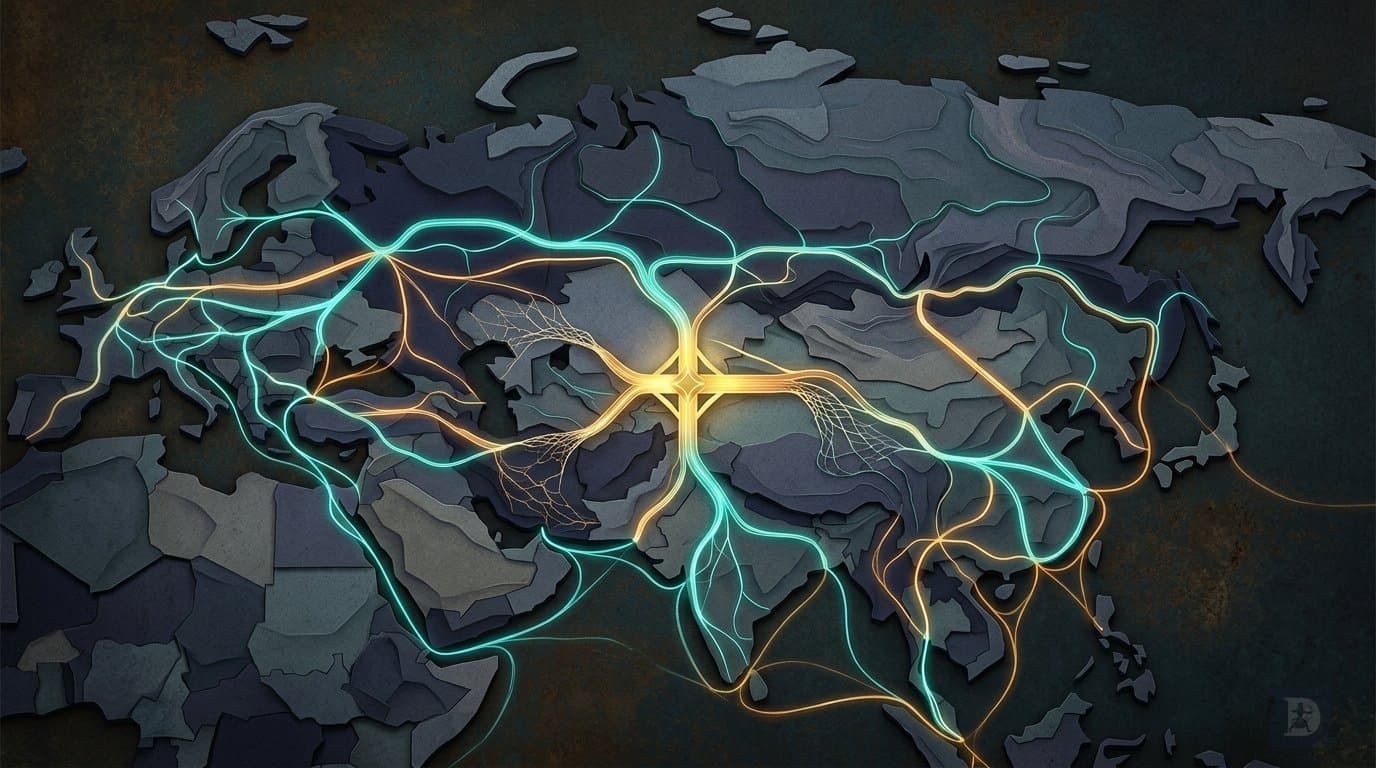
Strategic Summary: The Geoeconomic Outlook as of August 2026
By August 3, 2026 (12 Mordad 1405), the structural dissolution of the Western unipolar order has shifted from a gradual trend to an accelerated and permanent bipolarity within the international system. The transnational, globalized system of the post-Cold War era has given way to geoeconomic fragmentation, industrial protectionism, and localized supply chains. In this fractured geography, the Islamic Republic of Iran finds itself in a profoundly paradoxical position; a country previously defined as a sanctioned vacuum within the Western-centric global economy now serves as a vital land bridge and energy reservoir for the emerging Eurasian bloc led by China and Russia.
However, in the five-year horizon leading up to 2031 (1410 SH), Iran's capacity to transform this geographic and thermodynamic capital into systemic strategic leverage is severely constrained by acute domestic bottlenecks. The country faces a matrix of structural challenges: a sensitive political succession process, severe infrastructure imbalances, brain drain, and a crisis of capital accumulation. According to World Bank reports, Iran's economic growth rate has faced a 2.8 percent contraction, and the consumer inflation rate has stabilized at 42.2 percent. This strategic analysis maps the equations that will determine whether Iran achieves a forced integration into the non-Western trade architecture or succumbs to deeper stagnation due to structural attrition.
1. Geoeconomic Realignment: Iran as the Master Key to Eurasian Transit
During the era of unipolar hegemony, Iran's geographic position as a bridge connecting the Persian Gulf, the Caspian Sea, South Asia, and Europe was systematically suppressed by unilateral and secondary U.S. sanctions. However, by mid-2026 (1405 SH), the weaponization of Western sanctions and the blocking of traditional financial systems have compelled the Eastern bloc to prioritize land routes outside of Western control. Iran has transitioned from a state of geographic blockage to becoming the "master key of the defensive arc" within the Shanghai Cooperation Organization (SCO).
Acceleration of the International North-South Transport Corridor (INSTC) and the East-West Axis
The International North-South Transport Corridor (INSTC) is no longer a theoretical project. According to data from the Russian Ministry of Transport and Russian Railways, the total transit volume along this route reached 26.9 million tons in 2024, marking a 19 percent increase, with the rail sector accounting for over 12.9 million tons. Furthermore, along the eastern branch of the corridor, the volume of goods flow has tripled, reaching approximately 1.8 to 2 million tons. As a vital artery, this transit route secures Russia’s and the Caspian region’s access to the Indian Ocean without the need to traverse Western-controlled waterways.
From a financial perspective, this trade has become structurally independent of Western financial infrastructure. By mid-2026, more than 85 percent of Iran's transit and corridor revenues with INSTC partners are being settled through bilateral and multilateral monetary agreements, outside the SWIFT network. This positive financial isolation aligns with the geoeconomic fragmentation models of the International Monetary Fund (IMF)—models which indicate that restrictive trade regimes have increased the risk costs of traditional maritime routes by 15 to 20 percent, rendering Iran’s overland routes economically competitive, despite all domestic logistical frictions.
Regional Fragmentation and the Infrastructure Investment Crisis
Despite these macro-level achievements, Iran's transit potential faces two critical threats: disruptive regional rivalries and acute capital scarcity. The strategic competition between China’s Belt and Road Initiative (BRI) and India’s connectivity ambitions has led to the creation of fragmented transit nodes dependent on specific blocs, rather than an integrated national network. For instance, India’s focus on developing the Chabahar Port often stands in opposition to, rather than in synergy with, China-backed East-West corridors.
Furthermore, analysts at international research institutes warn that Iran's actual transit capacity remains constrained by aging infrastructure. While the country's theoretical transit capacity is estimated at 200 million tons per year, operational capacity remains below 10 million tons due to a lack of sufficient investment. Without an injection of at least $30 to $40 billion in capital to modernize rail lines, roads, and ports by 2031 (1410 SH), Iran will become a logistical bottleneck rather than a fluid thoroughfare—a structural weakness that the new, competitive global order will not tolerate.
2. The Protectionist Trap: Non-Oil Exports and Green Walls
Although the global shift toward regional supply chains has enhanced Iran's transit value, it has simultaneously challenged the competitiveness of the country's non-oil exports. The period from 2026 to 2031 is defined by a structural paradox: nominal integration into non-Western political blocs (BRICS and the Shanghai Cooperation Organization) does not automatically equate to an upgrade in industrial capacity.
The Carbon Penalty and the CBAM Mechanism
More than 65 percent of the value of Iran's non-oil exports consists of energy-intensive products such as petrochemicals, steel, and base metals. With the European Union's Carbon Border Adjustment Mechanism (CBAM) entering its penalty payment phase in January 2026, Iran's industrial exports are facing new tariff walls. Calculations indicate that CBAM carbon certificates will increase the cost of exporting Iranian steel and aluminum to target markets by up to 30 percent, effectively excluding Iranian producers from high-margin value chains. Although Iran lifted export bans on slabs and flat steel in August 2026 to generate foreign exchange revenue, the lack of access to green technologies for carbon emission reduction has rendered these products uncompetitive in developed markets.
Marginalization in Asian Value Chains
Iran's membership in BRICS has provided new diplomatic levers, yet the structure of Asian trade hinders deep economic integration. The Regional Comprehensive Economic Partnership (RCEP), which now dominates Asian trade, accounts for over 30 percent of global GDP. By remaining outside this pact, Iran faces significant preferential tariff disadvantages compared to competitors such as India, Vietnam, and Saudi Arabia. Based on Global Value Chain (GVC) participation indices, Iran exhibits high "forward participation" (exporting raw materials) and very low "backward participation" (importing intermediate goods for advanced manufacturing); a reality that reduces Iran to a mere supplier of raw materials for industrial hubs in China and Southeast Asia.
3. Thermodynamic Capital: The Gas Lever in an Era of Imbalance and Artificial Intelligence
The exponential growth of AI data centers and a new wave of industrialization have sharply increased global demand for baseload power. In this context, natural gas has gained renewed significance as a key transition fuel for grid stability. With 33.8 trillion cubic meters of natural gas reserves—approximately 16 percent of the world's total—Iran possesses unparalleled thermodynamic capital.
Pipeline Diplomacy vs. LNG Technology Sanctions
In a post-globalization world, Iran's energy strategy is centered on developing regional pipelines rather than Liquefied Natural Gas (LNG) projects. Technological sanctions have hindered Iran's access to gas liquefaction technologies; consequently, Tehran has focused on pipeline development to Iraq, Turkey, and the subsea pipeline to Oman. These pipelines serve as instruments for creating strategic interdependence, transforming gas from a simple commodity into a security tool.
The Paradox of Domestic Consumption and South Pars Pressure Decline
However, this thermodynamic leverage is severely threatened by domestic imbalances. The South Pars joint gas field, which supplies over 70 to 75 percent of the country's gas (according to Argus Media reports), has entered the second half of its operational lifespan. The decline in reservoir pressure has led to an annual production decrease of 10 billion cubic meters of gas (Ministry of Petroleum report). This imbalance manifested in the summer of 2025 as a 14,000-megawatt electricity deficit, resulting in widespread industrial power outages across 25 to 27 provinces (Tasnim).
To overcome this crisis and develop new phases, Iran requires an investment of at least $20 to $40 billion in the upstream sector by 2031. Within the framework of the 25-year Iran-China cooperation agreement, Chinese firms remain the only potential source for enhanced recovery technologies. However, without structural reforms in energy carrier pricing and domestic consumption management, any increase in production will be absorbed by the thirsty domestic market, limiting the country's export capacity to a negligible 40 million cubic meters per day.
4. Regional Geopolitics: Turkey-Israel Energy Convergence and the Shift in U.S. Security Posture
By August 2026, the balance of power in the Middle East will be defined more by the geometry of energy corridors than by traditional military presence. By reducing its regional ground forces to under 30,000 in 2026 (compared to 50,000 in late 2024), the United States has shifted its posture toward maritime deterrence in the Sea of Oman and the Persian Gulf.
The Israel-Turkey Energy Axis
This relative security vacuum has accelerated the pragmatic convergence of Turkey and Israel in the energy sector. Despite diplomatic tensions, both actors are aligned on transporting Eastern Mediterranean gas to Europe via Turkish territory. The Trakya gas hub project in Turkey, scheduled for late 2027, seeks to monopolize East-West energy transit. This corridor, which enjoys strategic backing from Washington, connects Mediterranean and Anatolian networks, effectively isolating Iran’s transit routes.
5. Asymmetric Financial Resilience and Liquidity Arbitrage
Faced with persistent threats in the Strait of Hormuz and the blockage of banking channels, Iran has developed its own strategies for asymmetric financial resilience. While the sovereign wealth funds of Persian Gulf states hold over $3.8 trillion in liquid assets, Iran’s National Development Fund faces severe constraints. To ensure financial survival, Tehran has leveraged its physical assets through innovative financial architectures.
Asset Tokenization and Parallel Cryptocurrency Networks
According to reports from blockchain analytics firms (such as Chainalysis), Iran's cryptocurrency transaction network reached $7.78 billion by 2025. The Central Bank of Iran, utilizing Distributed Ledger Technology (DLT), has initiated the process of tokenizing stored hydrocarbons. The settlement of these smart contracts in Chinese Yuan (CNY), Russian Ruble (RUB), and Indian Rupee (INR) allows Iran to bypass SWIFT sanctions. The use of Tether (USDT) and Bitcoin for placing import orders covered a volume equivalent to $3.2 billion last year.
Indirect Liquidity Arbitrage in the Persian Gulf
Given the declining real returns on traditional Western investments for Arab funds, Iran has established high-yield investment vehicles (SPVs) in neutral jurisdictions such as Oman and Iraq. These vehicles allow private and semi-state investors from Gulf Cooperation Council (GCC) countries to indirectly participate in Iran's mining, infrastructure, and reconstruction projects, thereby channeling a portion of the region's idle liquidity toward domestic projects.
6. Internal Structural Bottlenecks: Factional Rivalry, Succession, and the Human Capital Crisis
The most significant obstacle to implementing the aforementioned geoeconomic strategies is not external pressure, but rather structural decay and decision-making paralysis at home.
Political Rent-Seeking and Institutional Vetoes
The shadow of the political succession process looming over macro-level decision-making has sacrificed long-term economic planning for the short-term survival of factions. Friction between the moderate-leaning administration and the 12th Parliament has hindered the passage of reform packages in the banking and energy sectors. This uncertainty has fueled a historic capital flight of $27 billion in 2025 (a 4.5-fold increase compared to 2020, according to Central Bank data). To compensate for budget deficits, the Central Bank has resorted to monetizing the deficit, leading to a 35% growth in liquidity (M2) and the persistence of structural inflation.
The Triple Crisis: Labor, Capital, and Network Infrastructure
Iran's industrial sector is trapped in a destructive cycle:
- Specialized Workforce: According to OECD and Financial Times reports, the rate of elite emigration has reached over 115,000 individuals per year. The acute shortage of specialized personnel, particularly in the engineering and medical sectors (such as the 12,000-physician deficit reported by the Parliamentary Education Commission), has depleted domestic industries of their managerial and technical capacity.
- Capital: Foreign Direct Investment (FDI) inflows remain locked at a negligible $1.45 billion (equivalent to 0.3% of GDP), which is miles away from the $15–20 billion annual requirement for industrial reconstruction.
- Technology and Power Grid: The low efficiency of Iran's power transmission grid (with losses exceeding 15%) and the inability to procure heavy transformers due to sanctions have turned the electricity imbalance into a production bottleneck, which is projected to reach 15 gigawatts by 2031 (1410 SH).
7. Strategic Outlook (2026–2031): Structural Collapse or Forced Integration?
Over the next five years, Iran's economic trajectory will oscillate between two polar scenarios: the gradual collapse of production structures or resilient integration into the new Eastern trade architecture. The following table illustrates the variables determining this path:
| Key Variables | Structural Attrition Scenario (Status Quo) | Resilient Integration Scenario (Strategic Success) |
|---|---|---|
| Fiscal and Tax Reforms | Tax-to-GDP ratio remains at 7.5%; budget deficit monetization and inflation above 40% persist. | Transition from oil-dependent budgeting to an efficient tax system; stabilization of the Rial and curbing inflation below 25%. |
| Parallel Financial Channels | Chinese banks' fear of secondary sanctions; less than 15% of trade settled in national currencies. | Full operationalization of the BRICS payment system (BRICS Bridge) and risk hedging of transactions by Beijing and Moscow. |
| Upstream Investment | Intensified pressure drop in South Pars; Iran becomes a net gas importer, leading to industrial shutdowns. | Attracting $20–40 billion in Chinese investment under the 25-year agreement to install pressure-boosting platforms in South Pars. |
Ultimately, the decisive variable is not Washington's pressure, but the quality of decision-making among the ruling elite in Tehran. If political rent-seeking continues to obstruct structural reforms, even full membership in BRICS and the Shanghai Cooperation Organization will not prevent economic attrition. However, if the state can leverage its transit and thermodynamic cards to attract non-Western capital, Iran can secure its strategic survival as a vital and resilient node in the emerging multipolar order.