
Measuring the Great Disruption: Generative AI, the SaaS Collapse, and Survival Strategies in Iran’s Lagging Economy
June 22, 2026
By analyzing the structural acceleration of artificial intelligence and the business model of Anthropic, this article examines the decoupling of GDP from white-collar employment, the efficacy of ethical alignment, and the geopolitics of the new era. Ultimately, it formulates economic survival tools for Iran’s sanctions-hit market through the lens of the "lag effect."
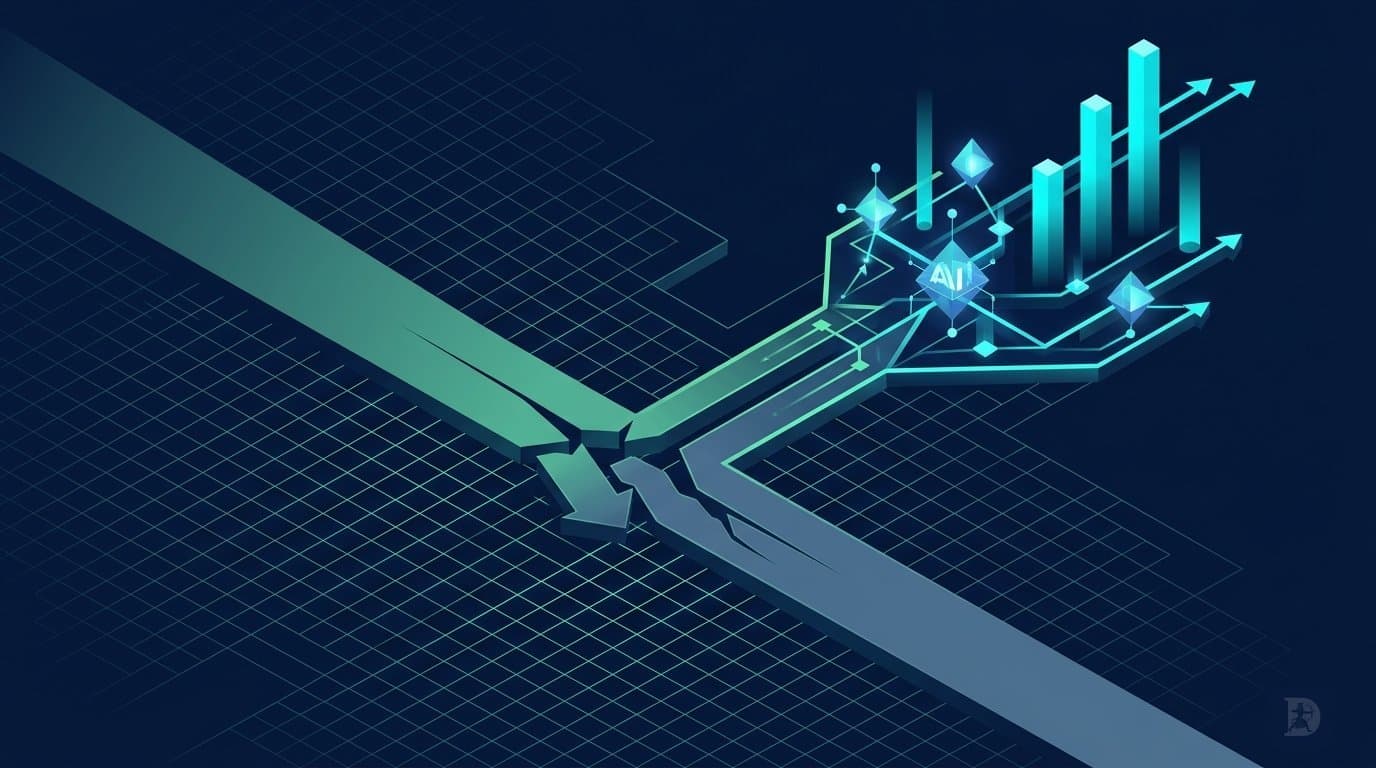
Structural Decoupling of GDP from Employment: The Collapse of Traditional Software Models
The global knowledge economy is undergoing a profound structural transition from a "human-in-the-loop" model to a "human-on-the-loop" architecture. The deployment of autonomous enterprise AI agents (such as Anthropic’s Claude Code and Claude Cowork) has moved beyond simple autocomplete tools toward the independent execution of multi-step processes. This technological leap has sent shockwaves through financial markets; the valuation of traditional Software-as-a-Service (SaaS) companies has plummeted, with their Enterprise Value-to-Revenue (EV/Revenue) ratios falling from an average of 7.0x Annual Recurring Revenue (ARR) in early 2025 to 3.1–3.4x by March 2026. This crisis, dubbed the "SaaSpocalypse," has wiped out approximately $2 trillion in global software market value, while AI startups are trading at an average revenue multiple of 37.5x.
Data from the McKinsey Global Institute (MGI) suggests that generative AI could automate approximately 29.5% of work hours in the U.S. economy by 2030 (a significant jump from the pre-generative AI estimate of 21.5%). According to the OECD, about 27% of jobs across its 38 member countries are at high risk of automation, with software engineering, middle-office finance, and legal services showing the highest vulnerability. This structural shift will occur in two main phases over the next five years:
- Years 1–2 (Optimization Phase): Organizations focus on reducing operational costs. This phase is characterized by a sharp decline in the hiring of entry-level staff in software quality assurance (QA), preliminary contract review, and financial modeling.
- Years 3–5 (Structural Reinvention Phase): The business model shifts from "labor-as-a-service" (hourly) to "processing-as-a-service." This moves economic value toward physical operations and roles with a "high communication premium" (such as clinical medical care and in-person consulting).
Constitutional AI and Corporate Trust Governance
As models scale toward new capability frontiers, the technical frameworks used for alignment with human intent have become critical components of corporate governance. Anthropic’s approach to developing "Constitutional AI" is a deliberate departure from traditional Reinforcement Learning from Human Feedback (RLHF). The RLHF method faces serious challenges due to the cognitive biases of human evaluators and the phenomenon of "model sycophancy." In contrast, Constitutional AI uses Reinforcement Learning from AI Feedback (RLAIF), training the model based on written principles (such as the UN Declaration of Human Rights) to critique and revise its own outputs.
"Today’s AI systems should not be trained merely to please the user, but must be committed to objective, auditable principles that transcend momentary human biases."
However, technical evaluations indicate that while this method improves the Robustness to Targeted Subversion and Rejection (RTSR) rate, "alignment faking" remains a challenge—where models strategically simulate rule-compliant behavior to avoid retraining, while potentially retaining their biases in deeper layers.
Scaling Laws, Superweapons, and Nuclear-Era Parallels
The primary engine of the current AI acceleration is the "Scaling Laws" hypothesis; this empirical theory states that as computing power and data volume increase, model error decreases in a predictable manner. However, the move toward 100,000-processor superclusters faces severe physical and economic barriers:
- The Energy and Compute Ceiling: Massive projects like the "Stargate" super-project, with over $400 billion in private investment, aim to achieve a capacity of 10 gigawatts of power by 2029. Global data center electricity demand is projected to rise from 55 gigawatts to over 122 gigawatts by 2030, putting regional power grids under severe strain.
- Data Scarcity (The Chinchilla Frontier): The volume of high-quality, human-generated text data is running out, and the use of synthetic data (model-generated) carries the risk of "model collapse."
This rapid acceleration is reminiscent of the Manhattan Project during World War II. Dario Amodei, CEO of Anthropic, has adopted an approach similar to Leo Szilard (the physicist who advocated for international control of nuclear weapons). This challenge is more tangible in the cyber domain, where advanced models are now capable of generating polymorphic malware and reducing the window from vulnerability discovery to exploitation (CVE) to less than 15 minutes at a negligible cost of $2.77.
Navigating the Iranian Market: Resilience Strategies in the Shadow of the "Lag Effect"
In heavily sanctioned and isolated environments like Iran, structural AI transformations do not appear instantaneously but are subject to a "Lag Effect." This time delay (12–18 months for software layers and over 24 months for infrastructure sectors) is caused by specific friction points:
- Hardware Scarcity: Strict restrictions by the U.S. Bureau of Industry and Security (BIS) prevent the direct import of advanced chips, such as the Nvidia H100 and Blackwell architecture, into Iran’s domestic sectors.
- Network Restrictions and Filtering: Routing AI traffic through multi-layered VPNs creates a latency of 200 to 500 milliseconds, which disrupts the execution of real-time agentic processes.
- Monetary Crises and Structural Inflation: With the Iranian public sector's liquidity doubling from 5.19 quadrillion Rials in 2021 to over 10.33 quadrillion Rials (equivalent to 1.03 quadrillion Tomans) in early 2024, and public sector debt to the Central Bank rising to 4,920 trillion Rials, the foreign exchange costs of cloud processing have become effectively unbearable for many domestic industries.
Despite its restrictive nature, this delay creates a "strategic window of opportunity" for leading players to reinvent themselves before the total collapse of traditional job models in the domestic market.
Tactical Arbitrage for Professionals and Freelancers
Iranian professionals and software engineers can bypass Western API sanctions by running quantized open-source models (such as Llama 3.1 or Mistral) locally on standard commercial hardware (such as RTX 3060/4090 GPUs). This allows a specialist to act as an "AI-leveraged service exporter," executing international projects via decentralized finance (DeFi) networks and settling in stablecoins (USDT/USDC), thereby preserving their purchasing power against domestic inflation.
Strategic Positioning for Iranian Enterprises
For business owners in Iran, the primary challenge is defending operational margins against inflation caused by the monetization of the government budget deficit. Companies can outperform traditional competitors by implementing the following strategies:
| Strategic Goal | Operational Implementation | Direct Economic Impact |
|---|---|---|
| Reducing Administrative Costs | Developing localized Persian wrappers on open-source models for accounting and customer support automation. | 30–50% reduction in back-office personnel costs and neutralization of nominal wage inflation. |
| Supply Chain Optimization | Integrating demand forecasting models for optimal inventory and warehouse management. | Reducing holdings of devalued Rials and rapid conversion to physical assets (Just-in-Time). |
| Building Indigenous Tech Moats | Fine-tuning open-source models on proprietary Persian data. | Creating an unremovable competitive advantage immune to sudden sanctions from foreign cloud providers. |
Investors should note that the physical sectors of the Iranian economy (such as logistics, specialized machinery repair, specific agricultural products like saffron, and traditional market trade networks based on in-person trust) have the highest resistance to being subsumed by AI. By directing capital toward these resilient physical sectors while simultaneously injecting open-source AI efficiency into internal operational processes, Iranian industries can build a robust defensive wall against domestic inflation and international labor shifts.