
The Physical Ceiling: How Memory and Energy Constraints Are Redefining the AI Economy
June 16, 2026
The era of assuming digital infrastructure costs would stay on a deflationary path is over. Memory and energy have transitioned from commoditized utilities to contested, strategic assets that now dictate the trajectory of AI development.
The Physical Ceiling: How Memory and Energy Constraints Are Redefining the AI Economy
For decades, the digital economy operated on the comfortable assumption that its foundational inputs—memory and electricity—would follow a deflationary path. Moore’s Law and the relentless optimization of power grids suggested that as technology advanced, it would become cheaper, faster, and more accessible. That era has ended. Today, we are witnessing a structural realignment where memory and energy have transitioned from commoditized utilities to contested, high-margin strategic assets.
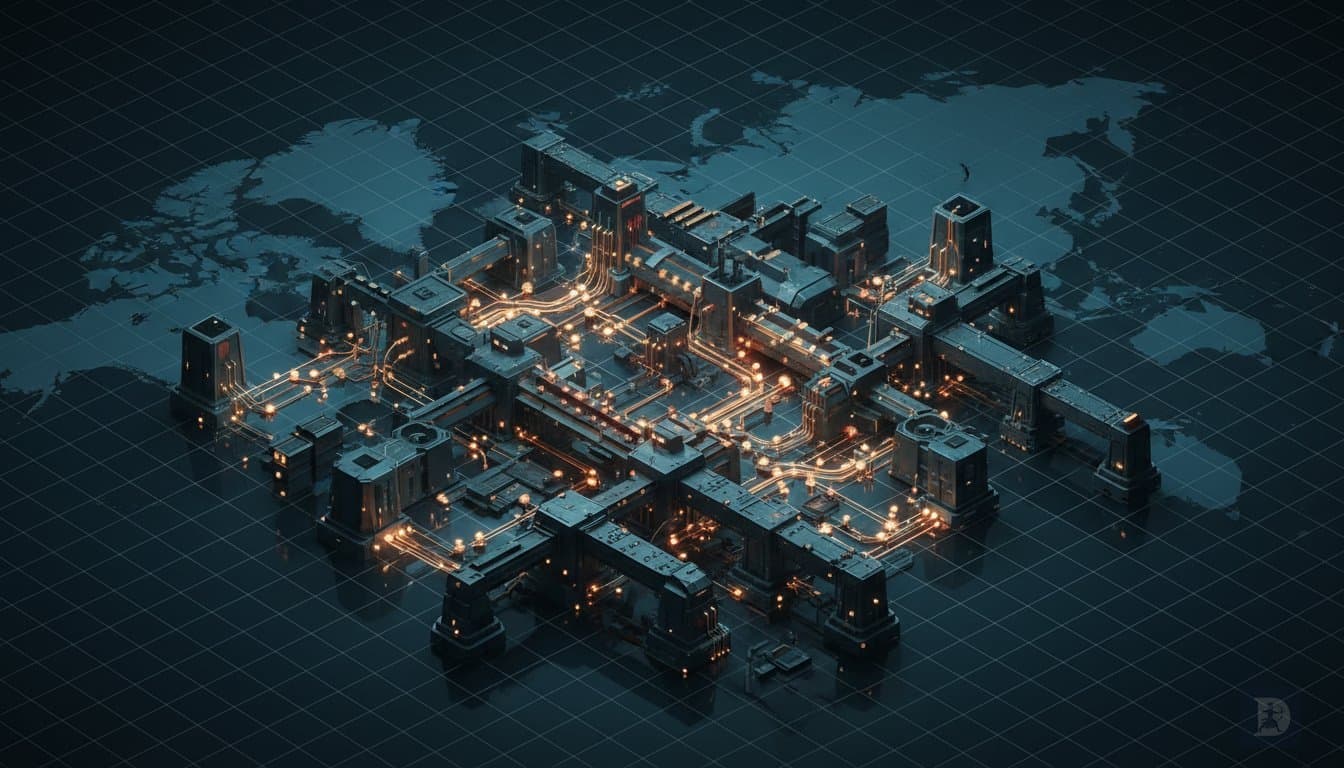
This shift is not merely a supply-chain hiccup; it is the physical manifestation of the AI 'super-cycle.' As AI models scale, their hunger for data throughput and constant, reliable power is turning the digital world into a physical bottleneck. For policymakers, investors, and industry leaders, the question is no longer just about software innovation, but about who controls the physical infrastructure—the 'workspace' of the machine—that makes that innovation possible.
The Memory Bottleneck: From Commodity to Choke Point
Memory is the computer’s workspace, and in the age of generative AI, that workspace has become intensely crowded. The industry is undergoing a fundamental transition from volume-driven commodity DRAM to performance-driven High Bandwidth Memory (HBM). HBM is a vertical stack of DRAM dies connected via Through-Silicon Vias (TSVs), designed to feed AI processors data at unprecedented speeds. This is not just an upgrade; it is a fundamental shift in manufacturing, requiring advanced 2.5D/3D packaging that is significantly more CapEx-intensive than traditional methods.
The numbers illustrate the scale of this disruption. By 2028, servers are projected to account for 59% of DRAM demand, up from 37% in 2023. This cannibalization of capacity is creating a two-tier market. While cloud hyperscalers secure priority access through long-term supply agreements and prepayments, traditional hardware manufacturers—PC and smartphone makers—are left to compete for the remainder. We project a potential 15% shortfall in PC memory and a 12% shortfall in smartphone memory by 2027, effectively forcing a 'spec-compression' or price hike across the consumer electronics landscape.
The Energy Inflection Point: The $5 Trillion Buildout
There is no AI without energy. As data centers evolve into industrial-scale power consumers, they are forcing a once-in-a-generation investment cycle. In Asia alone, the energy buildout required to support this growth is estimated at over $5 trillion in new investments over the next five years—nearly double the spending of the past decade.
The challenge is not merely generating more power; it is the reliability of the grid. Data centers require 'five-nines' (99.999%) availability, a standard that intermittent renewables struggle to meet without massive storage support. This has forced a pragmatic re-evaluation of baseload power. Coal, gas, and nuclear are being repositioned not as legacy assets, but as essential stabilizers for the AI-driven grid. By 2030, data centers could consume one-sixth of all new power generation in Asia, turning AI firms into major energy policy stakeholders.
Implications for the Broader Economy
The macroeconomic consequences of this transition are profound. We are seeing the end of the era where digital expansion was inherently deflationary. While the direct impact on headline CPI may remain muted at approximately 0.1% in 2026, the pressure on Producer Price Indices (PPI) is mounting. As the cost of 'factories of intelligence'—data centers—rises, those costs are being embedded into every downstream AI-enabled service.
- Two-Tier Market Dynamics: The emergence of a two-tier market—where hyperscalers secure priority access to memory and power—is creating a 'bottleneck of progress' for smaller tech firms.
- Industrial Policy Reconfiguration: Nations are shifting toward 'Strategic Autarky.' Industrial policy is no longer about efficiency; it is about resilience.
- The Cost Floor of AI-as-a-Service: As memory and energy represent an increasing share of the Total Cost of Ownership, we expect a shift toward value-based pricing, where the cost of AI is tied to the utility of the model rather than raw compute.
The future may look digital, but it is being built on an increasingly physical foundation. In the Daric perspective, the 'storm' of AI is not a fleeting trend; it is a structural shift in the equations that move the global economy. Understanding the physical constraints of this shift is the only way to map the terrain ahead.